

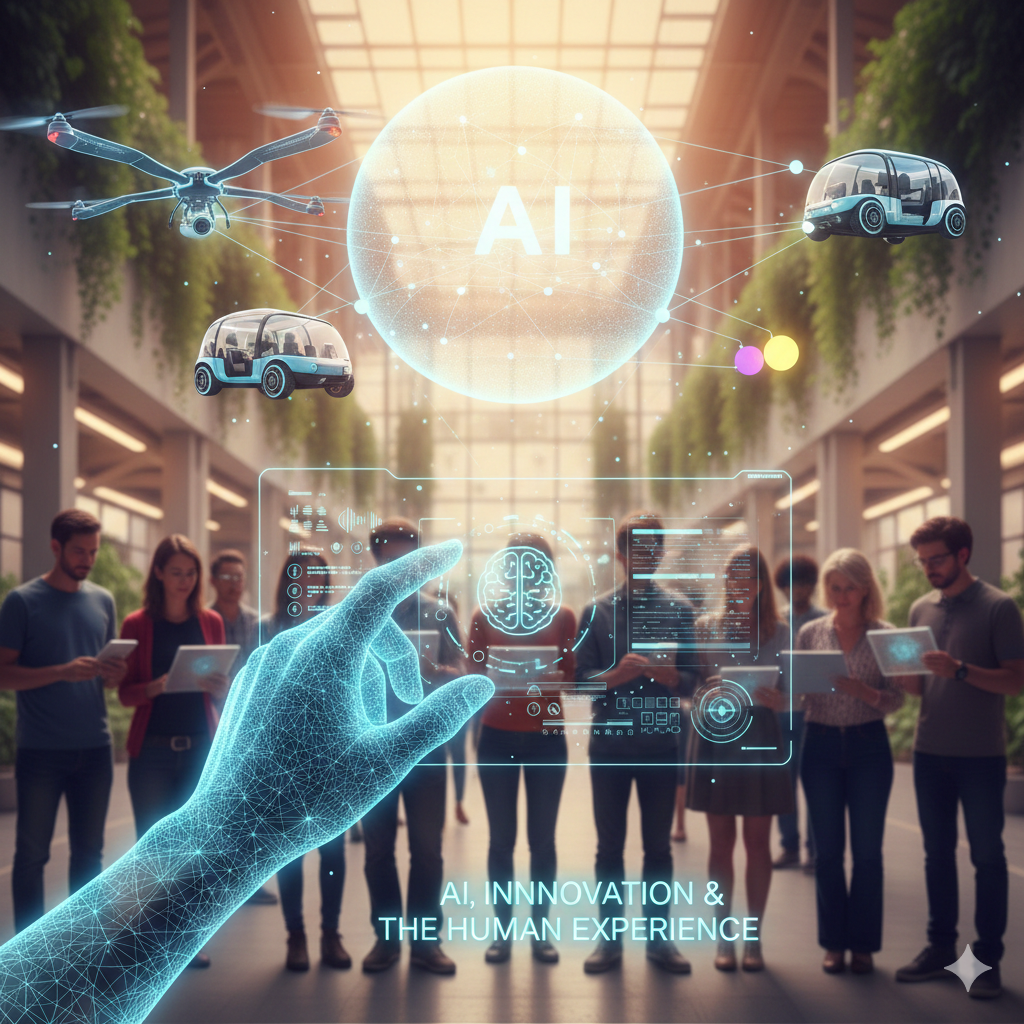
Artificial Intelligence (AI) is no longer a futuristic concept confined to science fiction. It is embedded in the fabric of modern life—powering search engines, recommending what we watch, assisting in medical diagnoses, and even helping to write content. As AI continues to evolve, it raises profound questions not only about technology but about what it means to be human.
Innovation has always reshaped society. From the invention of the printing press to the rise of the internet, transformative technologies have expanded human capability. Yet AI feels different. It does not merely extend physical power; it touches cognition, creativity, and decision-making—areas once thought uniquely human.
Understanding AI’s role in the human experience requires looking beyond efficiency and automation. It invites reflection on identity, ethics, connection, and purpose.
The Rise of Intelligent Systems
Artificial Intelligence refers to systems designed to simulate aspects of human intelligence—learning, reasoning, pattern recognition, and problem-solving. Machine learning, a subset of AI, enables systems to improve over time based on data.
Today, AI assists in countless industries. It predicts weather patterns, detects financial fraud, recommends medical treatments, personalizes education, and streamlines logistics. Smart assistants answer questions, while algorithms curate news feeds and online shopping experiences.
This integration makes AI feel invisible yet indispensable. The convenience it provides often goes unnoticed—until it disappears.
Innovation accelerates when machines can process massive datasets at speeds impossible for humans. But this acceleration also demands careful consideration.
Enhancing Human Potential
One of AI’s most powerful contributions is its ability to augment human capability. Rather than replacing human intelligence, many AI systems enhance it.
In healthcare, AI analyzes imaging scans to detect diseases earlier and more accurately. Doctors use these insights to make informed decisions. In scientific research, AI identifies patterns in complex data, accelerating discoveries in fields like genetics and climate science.
In creative industries, AI tools assist artists, musicians, and writers by generating ideas, editing drafts, and experimenting with new styles.
AI becomes a collaborator—a tool that extends imagination and productivity.
The key lies in partnership, not competition.
Automation and the Future of Work
Automation has reshaped labor markets before. The Industrial Revolution mechanized manual labor; the Digital Revolution automated clerical tasks. AI continues this trajectory by automating cognitive tasks.
Routine jobs in data entry, customer service, and manufacturing increasingly rely on AI-driven systems. While this improves efficiency, it also raises concerns about job displacement.
Yet history suggests that innovation often creates new roles alongside eliminating old ones. Emerging careers in AI development, data analysis, cybersecurity, and digital ethics continue to expand.
The challenge is adaptation. Education systems and workforce training programs must evolve to prepare individuals for new skill demands.
The future of work may emphasize creativity, emotional intelligence, and strategic thinking—qualities machines cannot easily replicate.
Creativity in the Age of AI
Can machines be creative? AI-generated art, music, and writing challenge traditional definitions of creativity.
AI systems learn from existing patterns and produce new combinations. While they can generate impressive outputs, they lack consciousness, emotion, and lived experience.
Human creativity draws from memory, emotion, cultural context, and personal narrative. AI may assist or inspire, but it does not replace human meaning-making.
Innovation in this space encourages collaboration. Artists use AI tools to experiment with new forms while maintaining human intention and storytelling.
The human experience remains central to authentic creativity.
Ethical Considerations
With great power comes responsibility. AI raises complex ethical questions.
Bias in algorithms can reinforce social inequalities. Data privacy concerns emerge as personal information fuels machine learning systems. Autonomous decision-making in areas like surveillance or defense introduces moral dilemmas.
Ensuring ethical AI requires transparency, accountability, and regulation. Developers must design systems with fairness and inclusivity in mind.
Society must engage in thoughtful dialogue about boundaries and safeguards.
Innovation without ethics risks harm. Innovation guided by responsibility fosters trust.
AI and Human Identity
As machines perform tasks once considered uniquely human, questions about identity arise. What distinguishes humans if machines can analyze, compose, and even converse?
The answer lies not solely in cognitive ability, but in consciousness, empathy, and moral reasoning. Humans experience emotions, relationships, and subjective meaning.
AI can simulate conversation, but it does not feel joy, sorrow, or compassion.
The human experience is deeply relational and emotional. AI may replicate patterns, but it does not possess awareness.
Recognizing this distinction helps maintain perspective.
Connection in a Digital World
AI shapes how people connect. Recommendation algorithms influence what content individuals consume. Social media platforms use AI to curate feeds and target advertising.
While personalization enhances convenience, it can also create echo chambers—limiting exposure to diverse viewpoints.
Balancing digital efficiency with authentic human connection becomes essential. Face-to-face interaction, empathy, and community engagement remain irreplaceable.
Technology should support connection, not replace it.
AI in Everyday Life
AI is present in daily routines. Navigation apps suggest optimal routes. Streaming platforms recommend shows. Smart devices manage home security and temperature.
These conveniences save time and reduce effort. Yet reliance on automation can diminish certain skills, such as navigation or critical thinking.
Mindful use of AI ensures it remains a tool rather than a crutch.
Awareness fosters balance.
Education and Lifelong Learning
AI-powered educational tools personalize learning experiences. Students receive tailored recommendations based on performance. Teachers use analytics to identify areas needing attention.
Online platforms leverage AI to provide interactive lessons and feedback.
This democratization of knowledge expands opportunity globally.
However, digital literacy becomes crucial. Understanding how AI works empowers individuals to use it responsibly and critically.
Lifelong learning becomes not just beneficial—but necessary.
Innovation and Responsibility
AI represents one of the most transformative innovations of the 21st century. Its potential is vast, but its impact depends on human intention.
Developers, policymakers, educators, and citizens share responsibility for shaping AI’s future.
Ethical frameworks must evolve alongside technological progress. Transparency, inclusivity, and accountability ensure AI benefits society as a whole.
Innovation guided by human values leads to sustainable progress.
The Human Experience at the Core
Despite rapid advancement, technology remains a reflection of human creativity and ambition.
AI does not define humanity; it amplifies human capacity.
The essence of the human experience—love, empathy, purpose, imagination—remains beyond algorithmic calculation.
Innovation can enhance life, but meaning arises from human connection and intention.
Conclusion
AI and innovation are reshaping the world at unprecedented speed. They enhance efficiency, unlock new discoveries, and expand creative possibilities.
Yet the true impact of AI extends beyond technology—it influences identity, ethics, and relationships.
The future lies not in choosing between humans and machines, but in integrating AI thoughtfully into human-centered frameworks.
When guided by clarity, responsibility, and empathy, innovation strengthens society.
The human experience remains central. AI may assist, accelerate, and analyze—but humanity provides purpose, compassion, and meaning.
As the future unfolds, the question is not whether AI will transform our world.
It is how we, as humans, will shape that transformation with wisdom and intention.